How Physical Therapy Can Help Your Posture

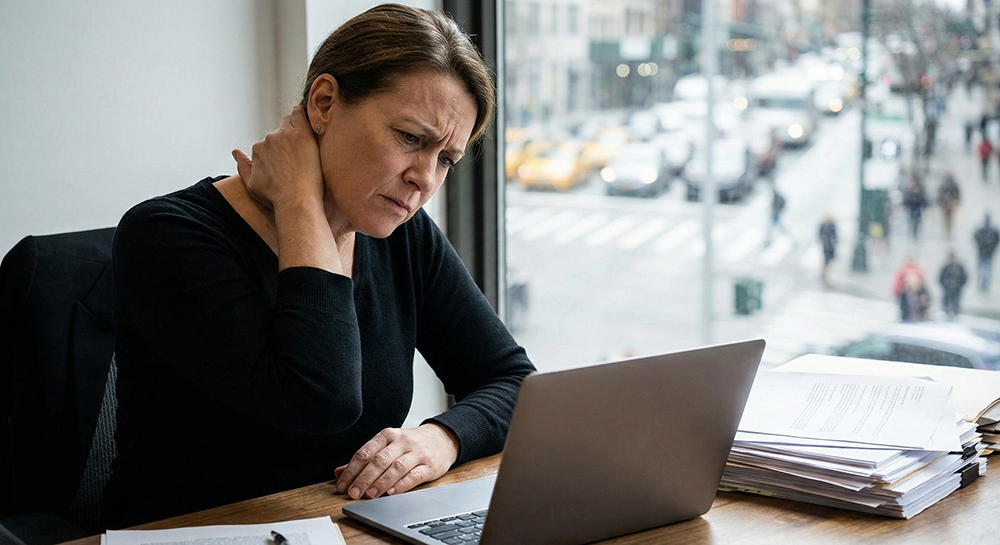
Do you catch yourself slouching throughout the day? Do you notice your spine gets sore those last couple hours of the school or workday? If you are experiencing aches and pains, especially in your neck or back, your poor posture may be to blame.
Most of us spend our day staring at a computer screen, riding in our car, or looking down at our phones. These slouched postures with our heads tilted forward or looking down cause stress to the muscles and joints of the neck and back.
The worse your posture is, the more intense your back and neck pain can become. Fortunately, your posture can improve with the help of physical therapy. Call Moore Myoworx today to learn more about how you can improve your posture and lead a pain-free, active life!
What are the natural curves of your spine?
Our spines are made up of four natural curves: the cervical, thoracic, lumbar, and sacral. When the spine is in its natural position, the vertebrae stack up over one another, and we call this “good posture” or sometimes “neutral spine.”
These natural curves, along with the intervertebral discs, absorb and distribute stresses from everyday activities such as sitting, standing, walking, or more intense activities such as running and jumping.
When you slouch, the spine in your neck and lower back becomes straighter, while the upper back becomes excessively rounded. This produces a forward-head posture, humped upper back and flattened lower back.
Ideally, our postures will change depending on our activities. Unfortunately, we often sink into poor postural habits and lose the natural stacked position our spines were designed to have.
What are the most common problems with bad posture?
Very few people have perfect posture. We become so wrapped up in whatever tasks we are doing that we forget to think about how we are holding our bodies. Most people ignore their posture until they begin to notice aches and pains.
Improper posture isn’t due to laziness but is generally due to bad habits, or at times, a physical weakness within our bodies. We slouch and slump when we get distracted or due to the design of our comfy couches and chairs. Poor posture leads to excessive strain on your joints, muscles, tendons, and ligaments.
Over time the sustained postures will affect the muscles needed to keep you upright and functioning at your best. Your body is designed to align perfectly to allow for proper movement of your muscles joints. When your spine is not stacked in the natural posture, it can affect breathing, digestion, and blood circulation.
If poor posture continues, it often leads to chronic conditions like back and neck pain. Poor postural habits can also affect your shoulders, especially reaching overhead. In more severe cases, the slouched posture can affect how you walk and negatively affect your balance.
What to expect in physical therapy
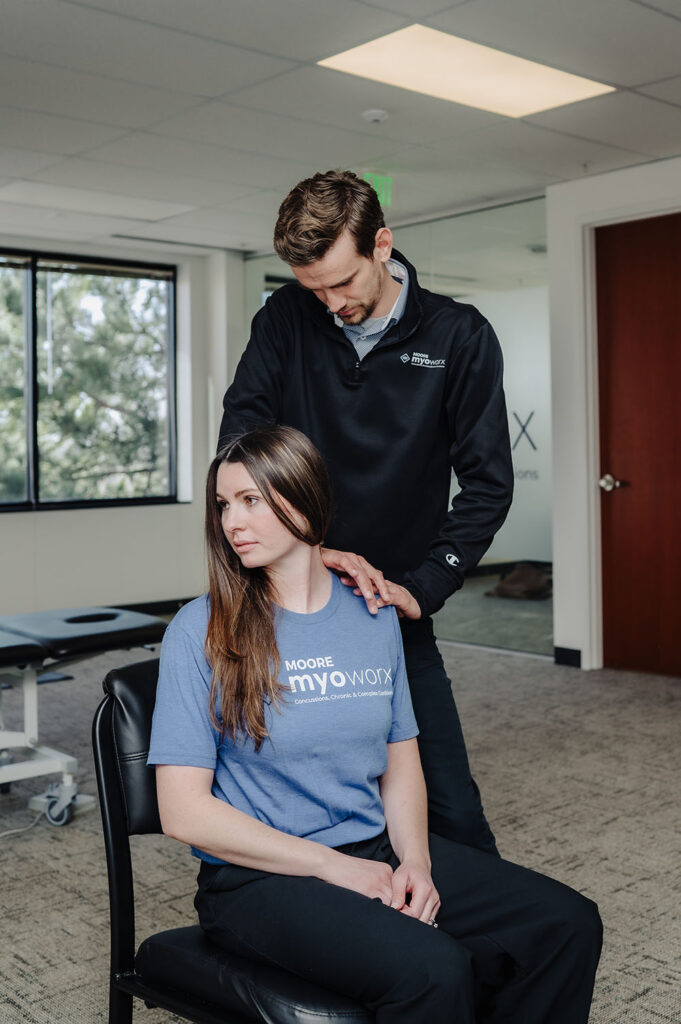
Our physical therapists are experts in evaluating posture and movement. By pinpointing the source of your aches and pains, we can develop a plan for you that will return you to an ideal posture and quickly relieve your pain.
Here are a few steps you can take to have an immediate impact:
Limit how long you sit
Prolonged sitting is not suitable for your back or your overall health. Although adjusting your posture while sitting can be helpful, a more practical option is to stand up periodically throughout the day. Limit your sitting to 30-45 minutes at a time.
Find your natural posture
The spine does not like to remain in any one position for extended times. By finding your natural posture, you can counteract the slouching you do throughout the day. Start by lifting your breast bone (i.e., sternum) towards the sky. This will naturally cause your spine to straighten out which will lift you into your natural posture.
Start strength training
Your body has hundreds of muscles. These muscles protect and control your spine. By lifting weights, running, and swimming, you can keep them strong. Train the muscles of your hips, pelvis, and spine — your core muscles — to help your posture.
Physical therapists are movement experts, and they are great resources to have when trying to achieve your physical performance goals. They will aid you in improving your balance, stability, flexibility, and mobility, all of which will positively affect your posture.
“They used a combination of electric spine stimulation and exercises to relieve my dizziness.“
“I am a highly active person living in the mountains just outside Denver. I love riding side-by-side buggies, snowmobiles, snowboarding, mountain biking and all the other activities available in the Rockies! Unfortunately, I have been experiencing situational dizziness! Doing yoga, getting teeth cleaned, riding on curvy roads, massage, basically anytime my head went below my heart! During these activities, I would suddenly have severe dizziness that led to nausea and sometimes caused me to throw up! I started to take Dramamine or avoid these activities alltogether. I did not want this to slow down my active life. Thus, I investigated online and found Moore MyoWorx. They used a combination of electric spine stimulation and exercises to relieve my dizziness. Taylor was my trainer to teach me these exercises. She was very knowledgeable and effective in providing me guidance and pushed me to learn and optimize each exercise! She did a great job and I have improved dramatically as I have been able to do yoga again as well as many other activities without dizziness. Taylor also provided me some exercises I can use if nausea starts while doing an activity. This has restored my confidence to do all these activities again. I highly recommend Taylor and MyoWorx! Keep pushing!”
—Chris N. — Actual 5-Star Google Review


Moore MyoWorx Teams Up with CU Buffs Players to Promote Concussion Awareness
Moore MyoWorx is teaming up with CU Buffs players Tyler Brown and Tawfiq Byard to help educate athletes, families, and the community about the importance of proper concussion care and prevention.
Concussions are a serious issue in sports, and early recognition and treatment can make all the difference in recovery. Through this collaboration, Tyler and Tawfiq will help share valuable tips, resources, and firsthand insights about concussion safety and the role physical therapy can play in recovery.
At Moore MyoWorx, we’re dedicated to providing expert concussion therapy and helping athletes get back to the game safely.
Exercise of the Month
Bridging
(Glutes, Lower Back, Hamstrings)
Begin on your back. Bend your knees and keep your back flat on the ground. Gently, contract your abdominals and hold to keep your back flat as you move up into the bridge position. Remember to breathe. Gently, squeeze your butt muscles and lift your hips off the ground. The goal is to have your hips aligned with your knees and shoulders. Hold for 5 seconds. 3 Sets, 10 Reps.
Contact us for an appointment
As part of your physical therapy treatment, we can teach you to find your natural posture to protect your body from future injuries and make sure you stay healthy!
Contact Moore Myoworx today to learn more about how we can help you live pain-free!

Feel Better by Eating Better!
Roasted Root Vegetables
- 12 oz rutabaga, peeled & cut into ¾-inch pieces
- 8 oz celery root, peeled & cut into 1-inch pieces
- 8 oz peeled baby carrots
- 8 oz fingerling potatoes
- 3 medium parsnips, peeled & cut into 1-inch-thick slices
- 1 medium fennel bulb, cored & cut into thin wedges
- 2 shallots, peeled & cut into thin wedges
- 2 tbsp olive oil
- ½ tsp salt
- ½ tsp ground pepper
Preheat oven to 325°F. Combine rutabaga, celery root, baby carrots, fingerling potatoes, parsnips, fennel, and shallots in a shallow roasting pan. Add oil, salt, and pepper; toss to coat. Bake, uncovered, for 1 hour, stirring occasionally. Increase oven temperature to 425°F. Bake, uncovered, about 10 minutes more or until the vegetables are tender and lightly browned.